


3 Sep 2026
1984 Bhopal Gas Disaster: the facts behind Darkling
- Our Plays
- The Bigger Picture
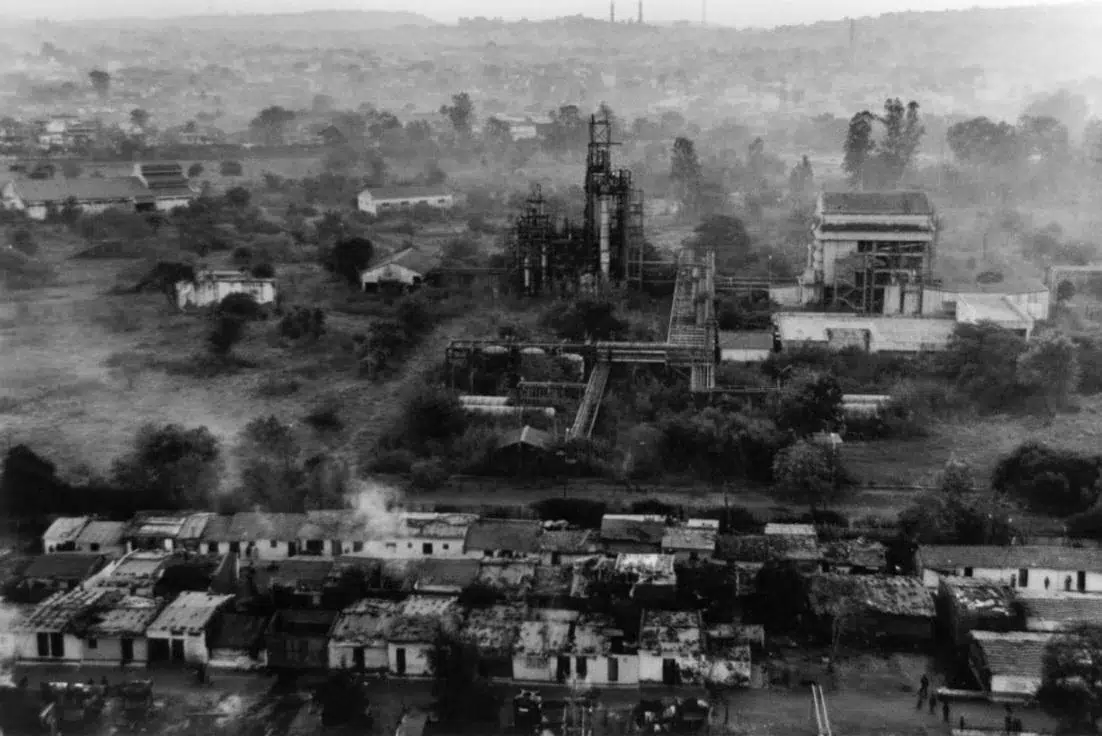
On the night of December 2nd, 1984, a violent chemical reaction inside an American-owned Union Carbide pesticide factory in Bhopal, India, caused a storage tank containing methyl isocyanate (MIC) to rupture, releasing around 40 tonnes of highly toxic gas into the surrounding city.
Darkling tells a fictionalised story of the life of one woman who spent her childhood in the shadow of the factory and was caught up in the disaster known as India’s Chernobyl. Here are the facts that inspired Titas Halder’s searing play, provided by charity partners Bhopal Medical Appeal.
Please note, by discussing the disaster, the below content includes descriptions of injury, death, pregnancy loss, injustice and ecological destruction.
Darkling plays in our Holloway Theatre until 24 October, and then tours the UK. Book here.
Deaths and Injuries
- In total roughly 570,000 people were exposed to the gas.
- More than 120,000 suffered serious or lasting injuries.
- Although fatality figures are contested, Amnesty International estimates 7-10,000 people died in the first 3 days after exposure.
- 160,000 people required medical treatment in the first 3 weeks.
- More than 25,000 have died in years since as a direct result of their exposure.
Health Impacts
- The primary cause of death in those who inhaled the gas was pulmonary oedema as their lungs filled with fluid. Other immediate effects included bronchial legions, heart attacks, blindness, concussion, and paralysis.
- Longer term effects of the gas included respiratory problems, chronic obstructive airways disease, cataracts or diminished vision, kidney or liver damage, uterine bleeding, and reproductive disorders
- Due to the immunological impacts on survivors’ bodies, studies have found them to be three times more likely to develop tuberculosis, four times more likely to develop kidney disease and eight times more likely to develop some form of cancer.
- Almost half of all pregnant women exposed to the gas went on to lose their babies before reaching full term. Those that did give birth encountered unprecedented rates of still-birth or congenital health problems.
- The inter-generational effects of gas exposure have been firmly established: rates of congenital disabilities like cerebral palsy and heart defects in children born into survivor families are up to seven times higher than the national average. A third generation of affected children are now being born in Bhopal.
- In the aftermath, doctors treating tens of thousands of victims did not know exactly what chemicals they had been exposed to or how those chemicals affected the human body. Union Carbide withheld important information about MIC and its effects, including research conducted by its own scientists, citing commercial secrecy. Doctors were therefore largely forced to treat symptoms rather than the underlying poisoning.
Compensation Settlement
- Union Carbide arrived at a settlement figure with the Indian Government, which was negotiated on behalf of the survivors and the bereaved, on February 14th, 1989
- The parties reached a settlement figure of $470 million, but much of this was not immediately paid out to the survivors.
- Survivors received only a pitiful $400-$500 each in compensation for life-changing or chronic injuries, while the bereaved received roughly $2,000 for each lost family member
- Those affected by chemical run-off and resulting water contamination in the decades since have never received a single rupee in compensation
- Three generations of children born since with congenital disabilities as a result of their family’s exposure have never been officially recognised as victims and are not eligible for compensation
Legal Case
- Union Carbide CEO Warren Anderson visited Bhopal the day after the disaster and was placed under house arrest. However, he was released by the Indian authorities and allowed to fly home. The U.S. Justice Department never extradited him to India and he would face no legal consequences prior to his death from natural causes in 2017.
- No foreign Executives would ever face legal consequences for the death by negligence of tens of thousands of people.
- Only 7 former Indian factory employees were put on trial for negligence, which didn’t take place until 2010 – 26 years after the disaster. They were sentenced to 2-year suspended sentences and a $2,000 fine – a sum that would have covered a single death in the original settlement – before being released on bail. Not one would ever spend a single day behind bars.
- An attempt by the Indian Government to re-visit the compensation via a ‘curative petition’ was rejected by the Supreme Court in March 2023.
- Union Carbide has never accepted responsibility for the disaster in the way demanded by survivors. Since acquiring Union Carbide in 2001, Dow Chemical has continued to deny responsibility for cleaning up the contaminated factory site and surrounding pollution. Dow representatives were still appearing in Bhopal courts in 2025, contesting legal responsibility more than 40 years after the disaster and 24 years after the merger.
Water/Environmental Contamination
- In the years before the disaster, workers from the factory had been dumping toxic waste in unlined pits on the factory grounds. Chemical run-off was directed into two large solar evaporation ponds directly outside the factory, only metres from the dwellings of local residents.
- Following the disaster, Union Carbide abandoned the factory without cleaning up the deadly chemicals and waste left behind, leaving contaminated soil and groundwater as an ongoing source of exposure for surrounding communities.
- By 1990, residents reported that the water they were drawing from local wells and pumps had turned a strange green-yellow in colour and developed a distinctly chemical smell. Those who drank it experienced stomach problems, headaches and skin conditions, as well as other more serious health issues.
- Groundwater testing by Greenpeace and other international groups in the 1990’s confirmed the water was contaminated with highly toxic materials, including organochlorides and heavy metals like arsenic and lead.
- Over time, the contamination continued to spread, affecting more than 42 local communities. The survivors took collective action to demand clean water from the Government, including walking the 400-mile distance from Bhopal to Delhi to in 2006 and again in 2008.
- Eventually the Government installed fresh taps and water tanks in some local neighbourhoods, but the tanks were insufficient to meet the need and inadequate pipe infrastructure allowed cross-contamination. Residents still report sewage entering supposedly clean water supplies
- In spring 2025, the Madhya Pradesh State Government removed 337 metric tons of waste from the factory grounds and transported it to the nearby town of Pithampur for incineration. Not only did the resulting fumes potentially endanger more people, the action did not address the thousands more tons of waste still buried below ground or the contamination remaining in the soil and local water supply.
- The disaster did not end in 1984. Today, more than 100,000 people in Bhopal continue to be exposed to contaminated water on a regular basis, and hundreds more children are born with health problems linked to the chemicals left behind by the disaster.



Join our mailing list
Sign up to our newsletter to receive all the latest news and updates from Bush Theatre.