


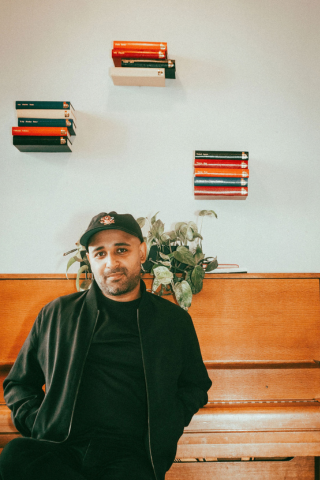
1 Oct 2026
“I have to write. It’s a compulsion. It’s a discipline.” | Meet Titas Halder
- Our People
- Our Plays
Following on from his huge success with Foal at Finborough Theatre, we’ve kicked off our 26/27 season with Titas Halder’s ferocious solo play Darkling. Titas actually wrote the play 16 years ago, so with just under 4 weeks of the run to go, we sat down to talk to him about solo plays, theatre going-habits, and why he decided it was time to stage this play now.
Q: How did you become a writer?
A: When I was at school our English teacher set the whole class a piece of homework: “write a scene”. We all wrote our scenes and he sent the entire class’s scenes to the Royal Court Theatre. The Royal Court wrote back and encouraged some of us to stay in touch. A few years later they invited me to join the Young Writers Programme. I was reading Harold Pinter and Debbie Tucker Green and Jez Butterworth and the Royal Court seemed like the coolest place in the world.
Q: Why do you write now?
A: I have to write. It’s a compulsion. It’s a discipline.
Q: What was the first play that you read that you fell in love with? Why and how has it impacted you as a writer?
A: Oh easy. One For The Road by Harold Pinter. I was given a copy which had production photographs in it by Ivan Kyncl. Alan Bates was Nicolas and Roger Lloyd Pack was Victor. It tapped directly into a teenage obsession with Tarantino and stuff like that. It’s the dialogue. The way that words can weave a spell. Years later I directed a student production of One For The Road and wrote to Roger Lloyd Pack. He invited me round to his house to chat about the play and made me a hot chocolate in a copper pan on the stove. He told me all about Pinter and Beckett. I got the sense that theatre people were properly warm and curious and connected.
Q: What other art inspired the style of this play?
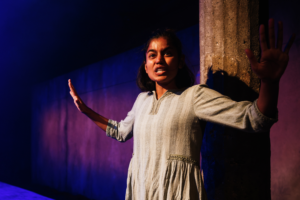
A: I remember seeing Random by Debbie Tucker Green at the Royal Court theatre Downstairs. An astonishing performance by Nadine Marshall. My memory of the play is of seeing the father and mother in the living room talking, the sister on her way to school, and of course the brother. But none of that is true. What I actually saw was one woman standing on a bare stage. The words alone managed to weave a whole set of images, and evoke an entire story. I wanted to try and do something like that, but for an actor who looked like my grandmother as a young woman.
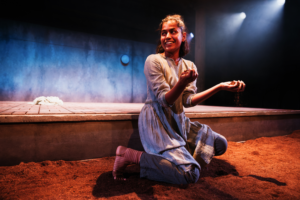
Q: Tell us more about Darkling: what was your writing process, how did it develop and change over time, and how would you describe it in a single sentence?
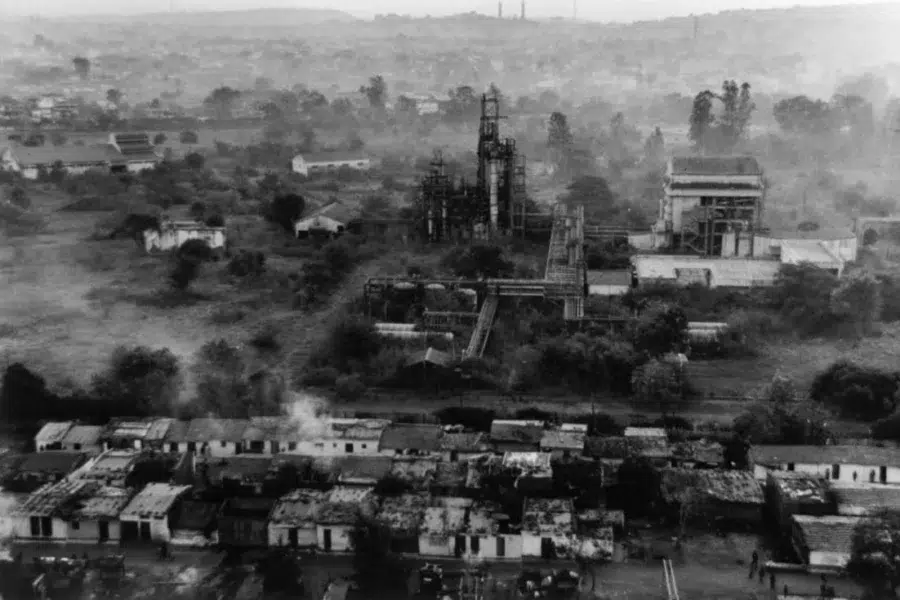
A: I wrote the play 16 years ago, when I was 22, so I was a different person then. I read a newspaper article about the 1984 industrial disaster in Bhopal. It was described as the world’s worst industrial disaster. I couldn’t understand how something could be described as the world’s worst of anything, and yet not be widely known about. I wrote it out of rage and injustice. The kind of which can only belong to a younger voice. I think in the article there was a picture of a girl. I envisaged trying to tell the complete life story of an imagined girl, whose life happens to be interrupted by the disaster. She has her own hopes, dreams, and ambitions, which are hijacked by the events of that day.
Q: What has been a standout moment in your career that has contributed to you being where you are today?
A: I guess the rocket boosters to the moon moment was getting the Donmar Resident Assistant Director job when I was 22. I was there under Michael Grandage during an incredibly cool moment for that theatre. Although I was there to train as a director, I felt like a secret spy; knowing that I was actually a writer, soaking up all this knowledge from rehearsal rooms. The lessons for a writer were massive; I got to learn from watching the most incredible actors – Helen McCrory, Celia Imrie, Derek Jacobi, many others. The lesson was to write good parts for actors.
Q: What other Bush show or playwright has excited you the most and why?
A: I’m going to go old school and say St. Nicholas by Conor McPherson, which was produced in the old Bush theatre above the O’Neill’s pub. There’s an introduction to the play where Conor talks about how he stuck a picture of Brian Cox above his desk while he was writing the play, never imagining that one day Brian Cox would actually agree to perform it. It’s an amazing and beautiful piece of writing, and taught me that a one-person play could be a whole proper evening at the theatre, and that an audience can be held rapt by one person telling a story. The simplest form of theatre, I guess.
Q: Describe your ideal routine when you go to the theatre to see a show.
A: Well, my least ideal routine is steaming off the tube and cramming a cold, soggy pret sandwich down your throat with five minutes to go before the show starts, then getting to the theatre to find your friend is late saying they will arrive at 7.29pm and you have their ticket. That is the most usual theatre routine, so my ideal one is whatever the opposite of that is.
Q: Outside of theatre, what’s your top cultural/leisure pastime and why?
A: I listen to music all the time. In a way, music is more of an influence on writing for me than anything else. I’m always plugged in to headphones. I’ve always got to find the right album to listen to for a project. So, I’d say live music. I’ve had the joy of seeing some amazing gigs. Stanley Clarke, Moses Sumney, Thundercat, Bilal, Red Hot Chili Peppers, System of a Down, Nine Inch Nails, The Mars Volta…
Q: What’s your top guilty pleasure cultural/leisure activity?
A: Like Roy Keane, I go and walk the dog.
Photos by Alec Brenner


Join our mailing list
Sign up to our newsletter to receive all the latest news and updates from Bush Theatre.